
Many students encounter the same words dozens of times and still continue to misspell them. This paradox comes from a common confusion in spelling instruction: seeing a word is not the same as knowing it.
The Difference Between Recognition and Active Recall in Spelling
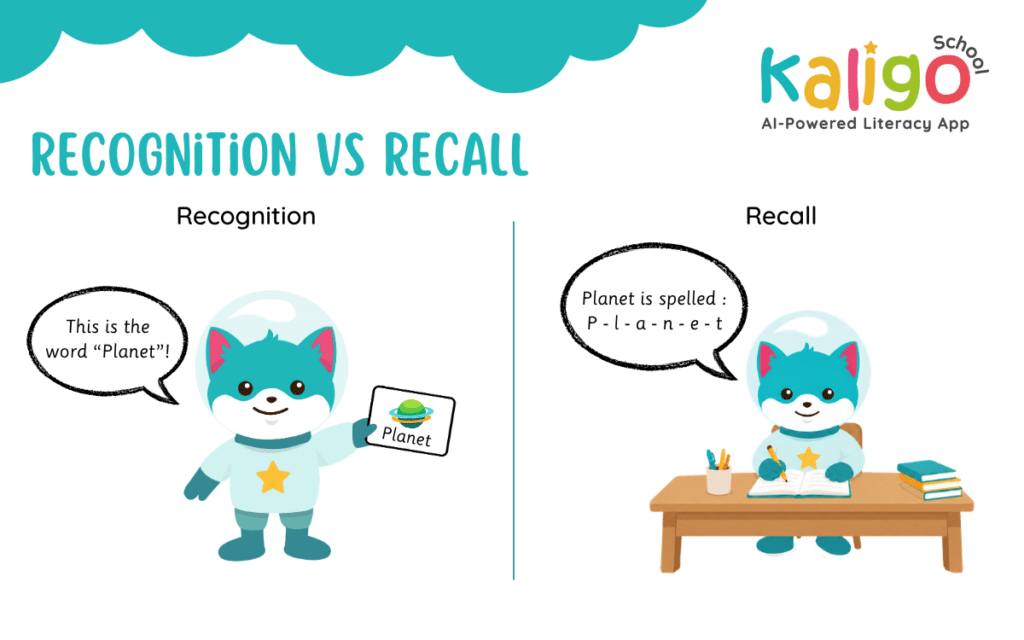
There is a major cognitive difference between recognising a word and producing it from memory.
A student may identify a word instantly when reading, feel a strong sense of familiarity with it, and yet be wholly unable to spell it correctly without support. This is not a sign of carelessness or insufficient effort, it reflects a well-documented feature of how memory works.
Recognition happens when the answer is already visible. Recall is active: it requires the brain to reconstruct information independently, without any safety net.
These two processes draw on different neural pathways. Active recall is one of the most powerful mechanisms for consolidating long-term memory.
Research on Active Recall
Since the 1970s, cognitive science has shed light on what is known as the testing effect: the act of retrieving information from memory is more effective for learning than rereading or passively copying it.
Roediger and Karpicke (2006) showed that students using free recall performed better on delayed tests. Students who simply reread the text felt more confident, but actually learned less effectively.
Robert Bjork developed the concept of desirable difficulties. These are moderate learning challenges that strengthen memory by requiring retrieval effort.. A student who struggles slightly to recall the spelling of a word learns more than one who copies it mechanically.
These principles apply directly to spelling: activities that require students to produce a word, rather than merely recognise it, create stronger and more lasting memory traces.
The Role of Handwriting in Active Recall
Handwriting is not a relic of an outdated pedagogy. It serves a specific cognitive function that typing does not replicate in the same way.
Writing a word by hand simultaneously engages:
- orthographic memory (the sequence of letters),
- motor memory (the physical act of writing),
- and sometimes phonological memory (the correspondence between sounds and letters).
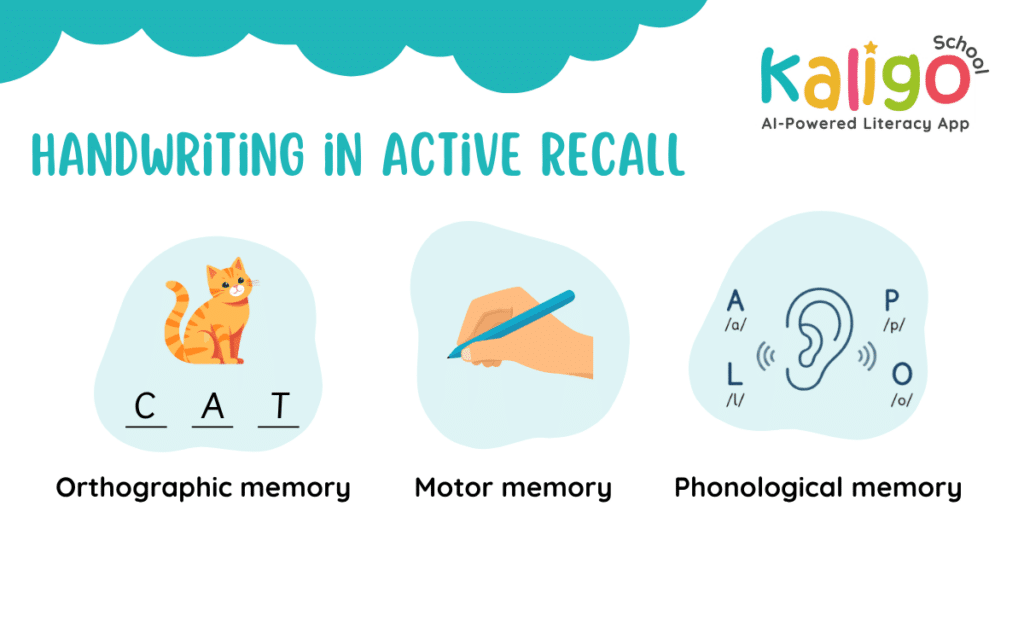
This multimodal engagement supports more robust consolidation. Research by Virginia Berninger suggests that handwriting activates brain regions linked to reading and writing in a highly integrated way.
That said, some nuance is warranted: the debate over the superiority of handwriting compared to typing remains open. The Mueller and Oppenheimer study (2014) is often cited in support of handwriting. However, later studies have questioned some of its conclusions. What does appear to be established is less about the medium and more about the nature of the activity: a task that demands active recall will be beneficial, whether carried out by hand or on screen.
Classroom Activities That Improve Spelling With Active Recall
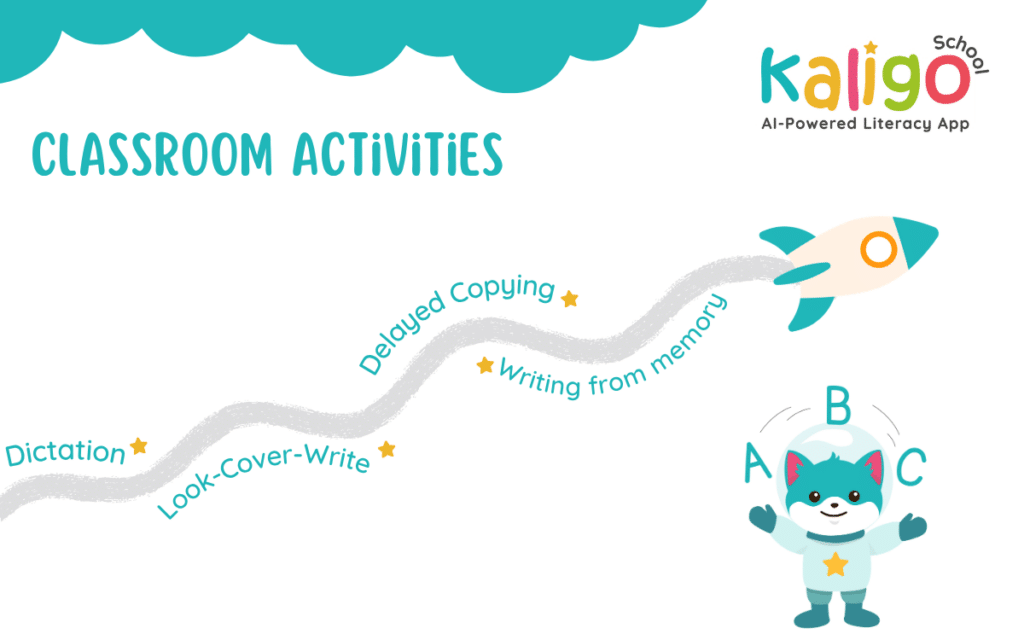
Certain activities make particularly effective use of active recall mechanisms in spelling:
- Dictation remains one of the most powerful. It requires students to retrieve the full orthographic form of a word from an auditory stimulus alone, with no visual support whatsoever.
- Look-cover-write: the student looks at a word, covers it, writes it from memory, then checks. This simple cycle engages recall at every stage.
- Delayed copying asks students to read and memorise a sentence first. They then write it without looking at the original. Even a brief delay of a few seconds is sufficient to transform passive copying into a genuine memory exercise.
- Writing from memory: after a period of study, the student closes their book and reconstructs the words or sentences studied. Each mistake becomes an opportunity for learning, not a mark of failure.
What these activities share is that they all impose a retrieval effort, however modest. It is precisely this effort that builds durable orthographic memory.
How Teachers Can Use Active Recall to Improve Spelling
The principal risk is what researchers call the illusion of competence: students mistake visual familiarity for genuine knowledge. Encountering a word frequently in reading does not guarantee being able to spell it.
A few practical principles worth keeping in mind:
- Space out revision: revisiting a word multiple times with intervals between sessions (spaced practice) is more effective than massed repetition over a short period.
- Vary retrieval formats: alternate between dictation, writing from memory, and production in context, rather than repeating the same exercise.
- Embrace productive error: a mistake made during a recall activity, followed by correction, reinforces memory more effectively than an error-free but effortless task.
- Avoid excessive copying: rewriting a word ten times in a row has little lasting effect on memory if the student is looking at the model each time.
Spelling and Active Recall in Kaligo
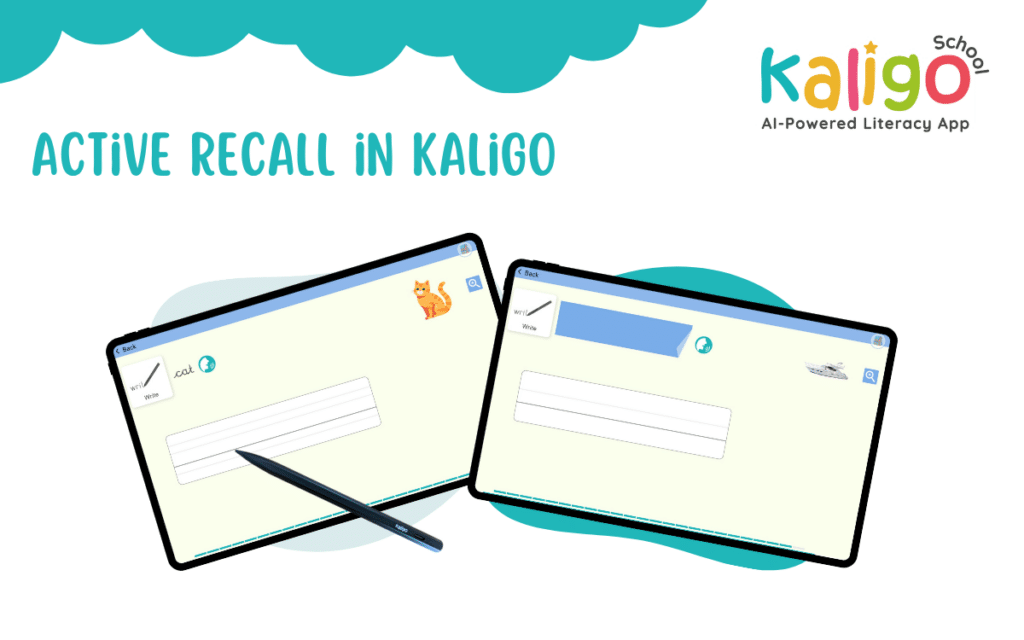
To bridge the gap between cognitive theory and classroom practice, Kaligo features a suite of targeted Spelling and Grammar (SPaG) exercises designed around active recall. For example, the “I can spell (look, cover, write)” activity prompts students to observe a word, watch it disappear, and then reproduce it entirely from memory using handwriting input. Unlike tracing activities, these exercises focus on spelling accuracy rather than handwriting quality, without relying on stroke-by-stroke verification.
Kaligo also offers an auditory spelling mode where students hear, and optionally see, the word they must reproduce. Instant AI-powered feedback helps identify spelling mistakes and encourages immediate correction and repetition.
Teachers benefit from a rich exercise library containing curriculum-aligned vocabulary for each school year, while also being able to create custom word lists or generate new words with AI based on specific Grapheme-Phoneme Correspondence (GPC) structures, which are a key phase of phonics learning. Different writing formats, such as uppercase or lowercase, can be selected depending on the learning objective, and activities can be linked with flashcards to reinforce retention through repeated recall practice.
Ready to see the impact in your classroom? Try Kaligo with a free 14-day trial and give your students hands-on, guided practice in a supportive and stimulating learning environment!