Recent results from UK schools show a clear pattern. While students are slowly doing better after the pandemic, they are still struggling with literacy, especially Writing and Grammar.
The Writing Challenge: Why Composition is Falling Behind Reading
The main issue is that it is much harder for students to write and produce their own work. It is easier for them to read.
Identifying the Literacy “Weakest Link” in Primary Schools
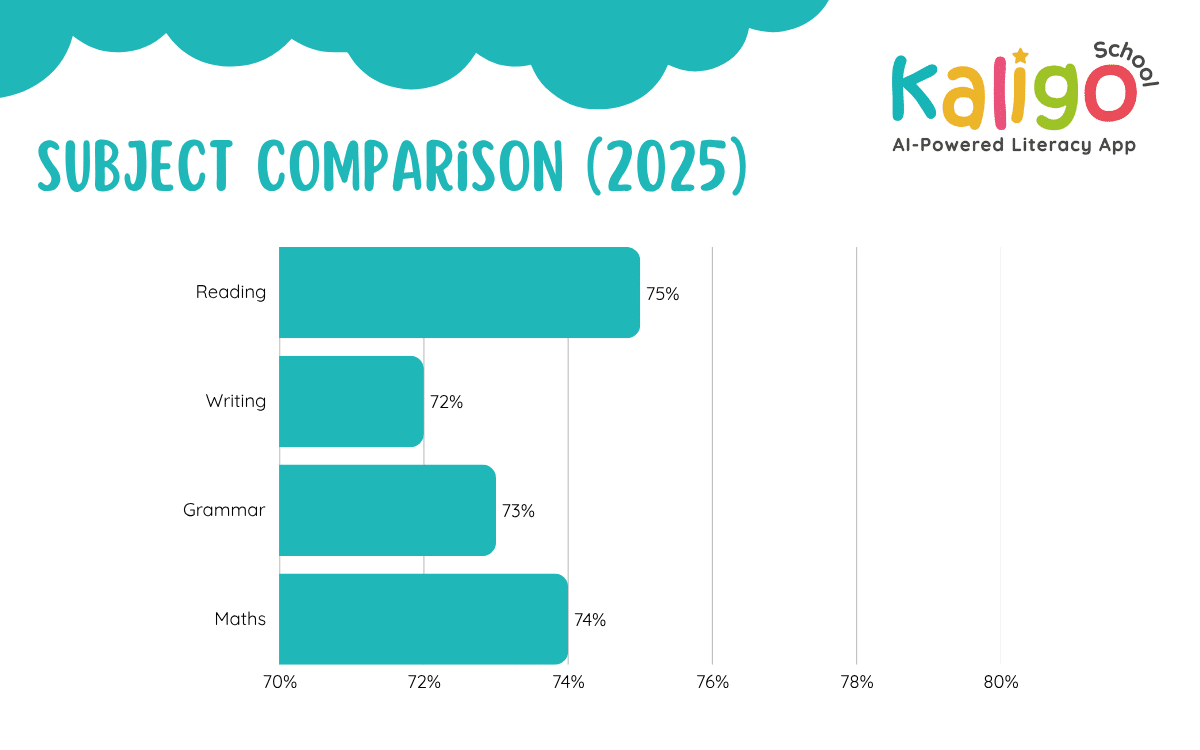
The academic data from 2025 reveals that Writing has become the primary area of concern. It is underperforming across all core disciplines, with a success rate of only 72%.
While subjects like Reading and Maths maintained higher benchmarks at 75% and 74% respectively, Writing struggled to keep pace. It even trailed slightly behind Grammar, which sat at 73%. This downward trend identifies Writing as the “weakest link” in the curriculum. It suggests that students are finding narrative construction and composition more challenging than technical literacy or numerical problem-solving.
These statistics were published by the Department for Education (DfE). They refer to all Year 6 students in state-funded schools in England who took the Key Stage 2 national curriculum assessments (SATs) in the 2024–25 academic year.
KS1 Writing Curriculum: Bridging the 6.10% Gap
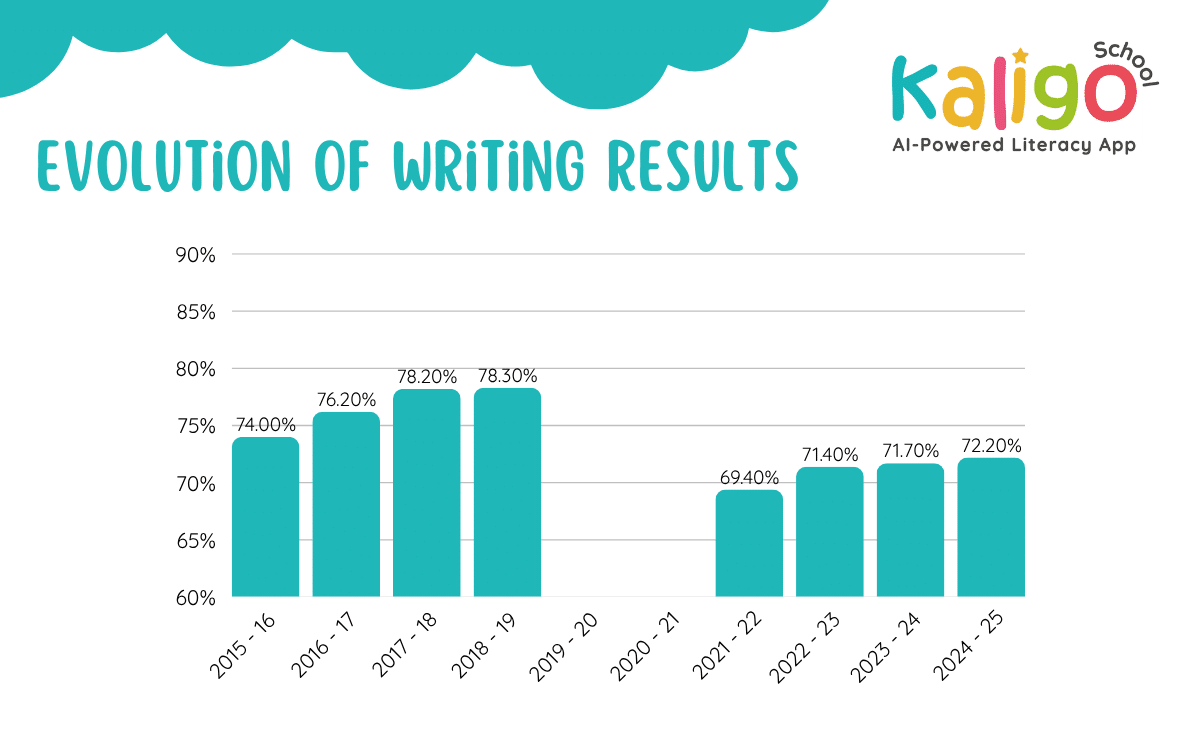
The evolution of Writing results from the SATs reveals a significant long-term decline in writing proficiency. It indicates that students still have a long way to go to reach previous standards.
In the UK, SATs (Standard Assessment Tests) are national exams taken by primary school pupils, usually at the end of Key Stage 2 (Year 6, age 10–11). They assess children’s abilities in English and maths to measure their progress and the performance of schools.
Although there has been a recent uptick in performance, the current score of 72.20% remains substantially lower than the 78.30% recorded in 2019. This persistent gap highlights that, despite modern recovery efforts, academic outcomes are still trailing behind the benchmarks set seven years ago.
Historical Performance Gap
- 2019 Benchmark: 78.30%
- Current Standing: 72.20%
- Net Decline: -6.10%
Returning to 2019 KS1 Writing and Spelling Benchmarks
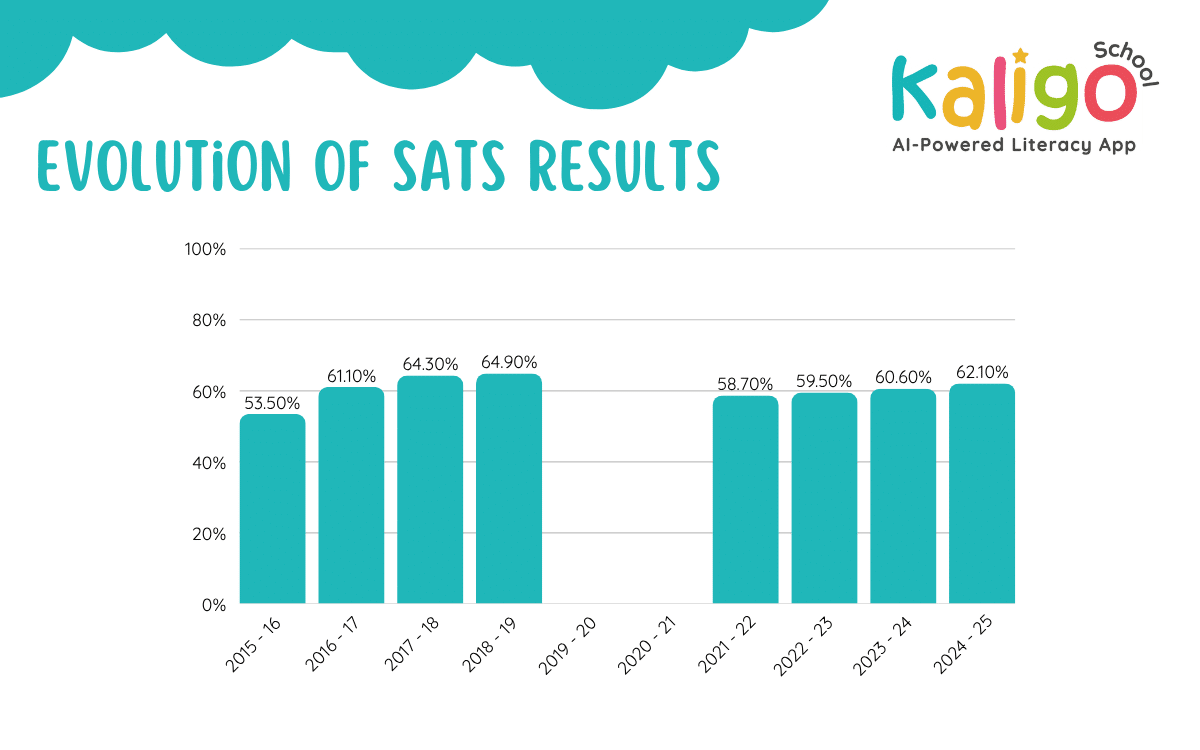
The evolution of SATs results illustrates a distinct “U-Shape” trend in academic performance. It is characterized by a period of steady growth followed by a sharp decline.
Prior to the global disruption, overall results climbed consistently until they peaked in 2019. However, the pandemic caused scores to crash significantly. While current trends show that scores are now slowly recovering, the existing average of 62.10% still fails to match the pre-pandemic high of nearly 65%. This indicates that the journey toward full restoration is still ongoing.
The Recovery Curve
- Pre-Pandemic Peak (2019): ~65.00%
- Current Average (2026): 62.10%
- Status: Partial recovery (Still 2.90% below peak)
These statistics were published by the Department for Education (DfE). They refer to all Year 6 students in state-funded schools in England who took the Key Stage 2 national curriculum assessments between 2016 and 2025.
Consequences of Poor KS1 Spelling and Writing Skills
When students struggle with basic writing, it creates a “domino effect” on the rest of their education:
Addressing the Secondary School Transition Deficit
A significant number of students are transitioning to secondary education without the foundational skills required for the advanced curriculum. This creates a ripple effect in the classroom.
This lack of preparation forces secondary school teachers to divert their attention away from new material. They must provide remedial instruction on primary school basics. Consequently, academic momentum is stalled. Valuable lesson time is consumed by bridging gaps that should have been addressed in earlier years.
The Transition Gap
- The Issue: Students entering secondary school “unprepared” for higher-level work.
- The Impact: Secondary educators are forced to act as primary instructors for fundamental concepts.
- The Result: A slower pace of learning for the entire cohort and a delay in covering the age-appropriate syllabus.
Closing the Knowledge Gap in Literacy Development
The disparity in achievement reveals a significant “Knowledge Gap” where student literacy is becoming lopsided. Because writing scores now trail reading scores by 3%, a trend has emerged. Students can comprehend and absorb information effectively. However, they struggle to articulate or synthesize those ideas in written form.
This deficit is not contained within English departments. It creates a friction point across the entire curriculum. Subjects like Science and History increasingly rely on a student’s ability to explain complex theories or historical arguments clearly on paper.
Breaking the “Avoidance Cycle” and Writing Anxiety in Students
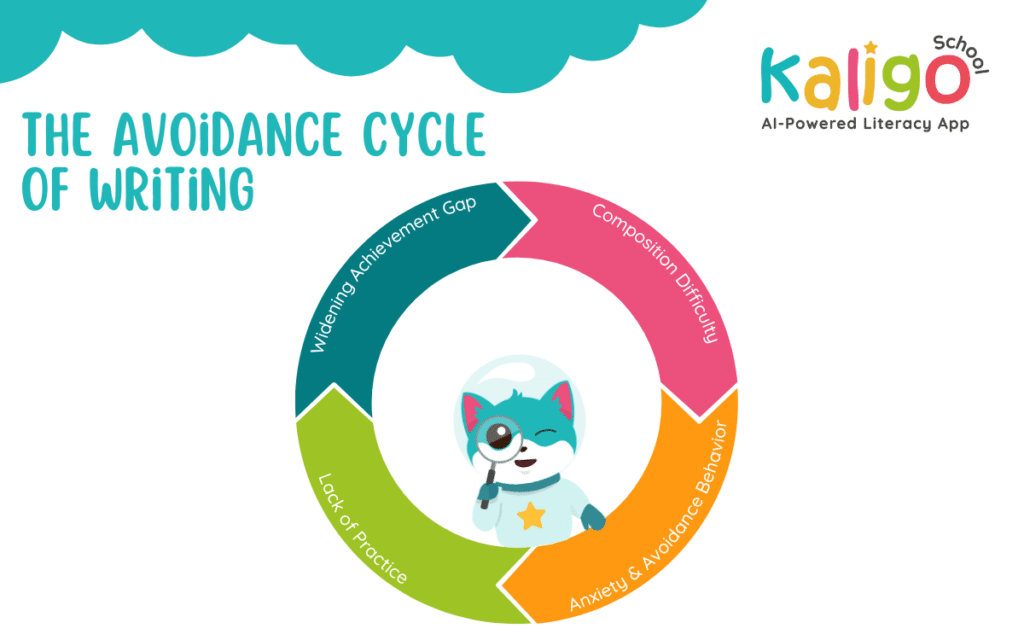
The struggle with writing often triggers a psychological loss of confidence. This creates a demotivating cycle that hinders long-term academic growth.
When students find composition tasks overwhelmingly difficult, they may develop a dislike for school. They may also begin to avoid assignments that require written output. This avoidance prevents them from getting the practice they need. It widens the achievement gap and makes it harder to catch up.
However, when feedback is immediate and non-judgmental, students become more involved in their learning. They begin to take ownership of their progress.
Innovative Literacy Activities: Shifting to Active Production
To return to the high standards seen in 2019, the focus needs to change. It must shift from “reading more” to “writing better.”
Recentering Writing Skills
To bridge the literacy divide, schools must shift toward active production rather than passive consumption. Daily writing practice should become a core pillar of the curriculum.
By using tools like Kaligo, educators can close the 3% gap between reading and writing. This ensures that students can express ideas as well as they understand them. This improvement creates a “rising tide” effect. Overall school results improve as communication barriers are removed.
The Benefits of Active Screen Time
The Kaligo App promotes active screen time. The device becomes a tool for creation rather than consumption.
- Higher Engagement: The interactive nature of the app demands constant participation, ensuring students stay focused on the task at hand.
- Increased Involvement: As noted earlier, immediate and non-judgmental feedback fosters greater student engagement in the learning process, leading them to take greater ownership of their progress.
- Productive Repetition: The gamified elements encourage students to spend more time practicing “boring” basics like stroke order and spelling without the fatigue associated with traditional worksheets.
Using AI Tools to Drive Engagement in KS1 Spelling and Writing
Schools are increasingly turning to the Kaligo App. It is an innovative digital tool that uses Artificial Intelligence (AI) to improve handwriting and spelling.
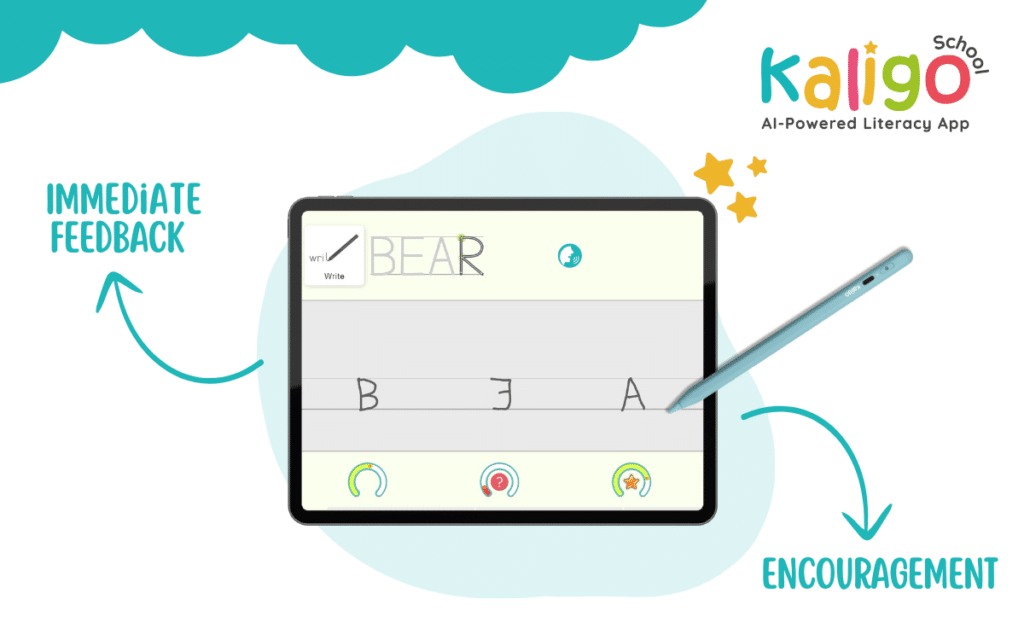
Students practice on tablets and receive instant feedback on letter shapes and strokes. The app acts as a personal tutor. It corrects errors in real time. This gamified approach makes learning engaging. It motivates students to practice more often and more accurately.
Features of AI-Driven Handwriting
- Real-Time Correction: Students receive immediate visual cues to improve their penmanship and stroke order.
- AI Integration: The software analyzes handwriting patterns to tailor the difficulty level to each child’s specific needs.
- Encouragement: Turn-based rewards and interactive challenges help reduce the “writing anxiety” mentioned previously. (à changer dans le visu)
- Data Insights: Teachers can track progress through a digital dashboard to identify which students need extra support.
Mastering KS1 Spelling and Grammar to Drive Writing Fluency
A strong literacy framework begins with Grammar and Spelling. These are the building blocks of written communication.
With grammar proficiency at 73%, targeted improvement is essential. It helps students move from basic literacy to expressive fluency. As students master these mechanics, they gain confidence. They can construct complex, grammatically sound sentences.
This makes writing more manageable. It transforms it from a source of frustration into a structured and rewarding process.
Accelerating KS1 Writing and Spelling with Interactive Literacy Activities in Kaligo
Kaligo provides an interactive platform to accelerate literacy development. It blends structured pedagogy with gamified activities. Students improve reading, writing, spelling, and comprehension. They also build confidence as communicators.
The platform uses adaptive exercises and instant feedback. Each child progresses at their own pace. From phonics to complex sentence construction, Kaligo supports educators with a structured approach.
Start your free 14-day trial today. Help your students gain the skills they need to succeed.
Free Writing and Spelling Resources to download :
To support classroom and home learning, we offer a range of free literacy activities to download, designed specifically to:
- Master KS1 spelling by identifying tricky silent letters in common words.
- Improve KS1 writing through the correct use of capital letters for names, places, and sentences.