
Literacy development plays a crucial role in a child’s overall learning and progress, particularly within the Early Years Foundation Stage (EYFS) and primary education. It refers to the ability to read, write, speak and understand language, which are essential skills for effective communication and lifelong learning.
In the UK, children begin developing these key literacy skills during the early years foundation stage, where a strong emphasis is placed on communication, language, and early reading and writing. The National curriculum in England further supports this development by providing a structured framework that focuses on reading, writing, spoken language, and comprehension skills throughout primary education.
Through a range of structured and play-based activities, such as sharing stories, mark-making and early writing, practising phonics, and engaging in speaking and listening opportunities, children progressively build their literacy skills. These experiences support early reading through decoding and comprehension, as well as writing through encoding and vocabulary development.
Strong literacy skills are fundamental to academic achievement, as they enable children to access the wider curriculum across all subjects. In addition, literacy development supports confidence, social interaction, and self-expression. Developing literacy from an early age within the EYFS and beyond is therefore essential in helping children succeed both in school and in their everyday lives.
What Is Literacy in Early Years?
Literacy isn’t just about reading and writing, it’s a mix of different skills which are all linked together. It starts with Phonics, where children learn how sounds and letters work together to form words. From there, Reading helps them become more fluent and understand what texts actually mean. Writing lets children express ideas, using both structure and creativity. Grammar, Spelling, and Punctuation help build accuracy in writing. And finally, Speaking and Listening are important for communicating and understanding others in everyday situations. Altogether, literacy is really a complete set of skills that work hand in hand.
Phonics: Building Strong Foundations
Understanding Phonics in Early Literacy Development
Phonics is a fundamental approach in early literacy instruction that teaches children to read and write through the systematic relationship between sounds and letters. It is based on the understanding that spoken words are composed of individual units of sound, known as phonemes, which are represented in written form by graphemes. These grapheme–phoneme correspondences (GPCs) are explicitly taught to support both decoding (Reading) and encoding (Spelling).
Phases of Phonics Development
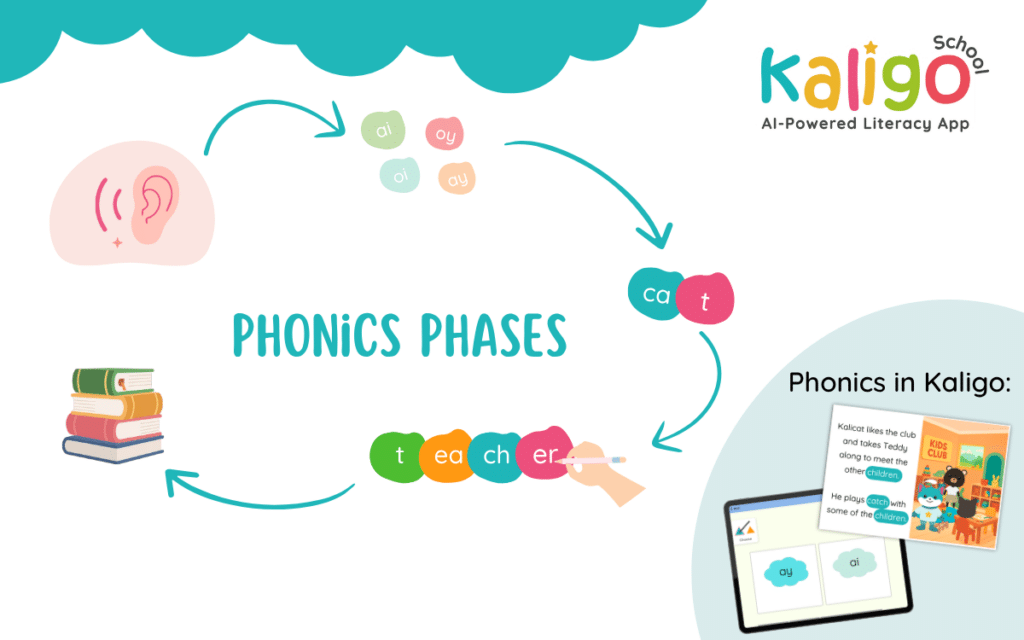
In UK primary schools, phonics is typically delivered through a structured, progressive programme divided into phases:
- Phase 1: focuses on developing children’s auditory discrimination and listening skills. Activities include identifying environmental sounds, distinguishing between different phonemes, and beginning oral blending and segmenting without written text.
- Phases 2 and 3: introduce specific GPCs, teaching children the relationship between letters and sounds. Students learn to apply blending (synthesising phonemes to read words) and segmenting (breaking words into phonemes for spelling), enabling them to decode and encode simple words.
- Phase 4: consolidates previously learned GPCs and phonemic awareness. Children practise blending sounds in longer words and segmenting more complex phoneme sequences, including adjacent consonants, to improve fluency and accuracy.
- Phase 5: extends children’s knowledge of the alphabetic code by introducing alternative graphemes for known phonemes and alternative pronunciations for known graphemes. This deepens their understanding of spelling patterns and supports more fluent and flexible reading and writing.
This cumulative and systematic approach ensures that children develop strong foundations in phonemic awareness, secure knowledge of GPCs, and the ability to blend and segment sounds effectively for both decoding and encoding.
Supporting Phonics Learning with Digital Tools
Kaligo supports Phonics through a range of interactive exercises that actively engage children in linking sounds and letters.
With over 550 ready-to-use lessons, the Kaligo Phonics Programme offers an extensive library of scaffolded and interactive content to build essential reading and writing skills step by step.
For example, students write letters while hearing their corresponding sounds, helping them associate graphemes with phonemes. They also complete activities where they identify or write the correct letter for a given sound, as well as practise blending by writing simple words while listening to each individual sound. Segmenting tasks further support spelling by encouraging children to break words into phonemes before writing them. Through repeated practice and immediate feedback, these exercises reinforce sound–letter relationships and help build confidence in early reading and writing skills.
Learn all about our Phonics Programme in our dedicated article on this topic!
Reading: Fluency and Comprehension Skills
Reading is a central aspect of literacy that involves both fluency and comprehension. Fluency refers to the ability to read texts accurately, smoothly, and with appropriate expression, allowing children to focus on meaning rather than decoding individual words. Comprehension, on the other hand, is the ability to understand, interpret, and respond to what is being read.
At primary level in the UK, children develop these skills through a structured approach that includes:
- Fluency: reading accurately, smoothly, and with appropriate expression.
- Comprehension: understanding, interpreting, and responding to texts.
- Exposure to texts: reading a variety of books and materials.
- Guided activities: participating in questioning, discussion, and reflection.
As students become more fluent readers, they are better able to engage with texts, identify key ideas, and make connections. Developing strong reading skills is essential, as it supports learning across all subjects and fosters a lifelong engagement with reading.
Supporting Reading Development with Digital Tools
Kaligo supports Reading by reinforcing word recognition and encouraging repeated exposure to written language through interactive writing tasks. As children trace and write words and short sentences, they become more familiar with common vocabulary, which helps them read more accurately and smoothly.
This repeated practice supports fluency by reducing the effort needed to decode individual words and lightens the cognitive load. At the same time, Kaligo promotes comprehension by helping learners engage with the meaning of the words and sentences they are writing, often supported by visual or contextual cues. Through structured progression and regular practice, children build confidence in recognising words, understanding simple texts, and gradually developing the skills needed to interpret and respond to what they read.
Writing: Learning to Write from Foundations to Expression
Pre-Writing Skills in Early Literacy Development
Writing is a fundamental component of literacy that combines both structure and creativity. Before children are able to write effectively, they must first develop essential pre-writing skills, which form the foundation of successful writing. These include fine motor control, hand–eye coordination, and pencil grip, all of which enable children to make controlled and purposeful marks on paper. Developing these early skills often involves activities such as drawing, tracing, and pattern-making, which help strengthen the small muscles in the hands and fingers.
Good posture and positioning is equally important. Children need to be seated comfortably with both feet on the floor, a straight back, and the paper positioned correctly to support natural hand movement. A proper pencil grip and relaxed arm movement allow for greater control and reduce fatigue, supporting longer and more effective writing sessions.
Handwriting practice
Pre-writing allows children to lay the foundations for handwriting. Once the graphomotor skills associated with writing have been introduced through pre-writing, the children can focus on handwriting. Shape, size, order and direction of the strokes, all come into play to allow the children to learn and develop their own handwriting. Through real time feedback, children understand their mistakes right away and are able to keep on working on the mistakes they have just made. Teachers and educators are then able to oversee the work which has been done and understand where the mistakes were made and why.
The aim is to allow children to automatise their handwriting. This, in addition with improved accuracy while writing, will allow for freed up cognitive load. The children will be able to focus on ideas, notions and concepts that are being conveyed through the writing, instead of the words themselves;
Developing Writing Skills in the Curriculum
As these physical and developmental foundations are established, writing involves the ability to organise ideas clearly, use appropriate grammar and vocabulary, and adapt language to different purposes and audiences. Within the UK primary curriculum, children develop writing skills through a structured approach that includes:
- Sentence construction: learning how to form clear and grammatically correct sentences.
- Text organisation: developing paragraphs and structuring different types of texts, such as stories, descriptions, and explanations.
- Use of vocabulary: choosing appropriate and varied words to express ideas effectively.
- Creativity: expressing imagination, personal experiences, and original ideas through writing.
- Planning and editing: learning to plan their writing and improve it through revision and correction.
Through guided practice, attention to physical readiness (such as posture and grip), and regular feedback, children gradually improve their ability to write with accuracy and coherence. Developing strong writing skills, supported by secure pre-writing foundations, enables students to communicate effectively and supports their overall academic progress.
Discover our Kaligo’s Handwriting Learning Guide to know more about it !
Supporting Writing Development with Digital Tools
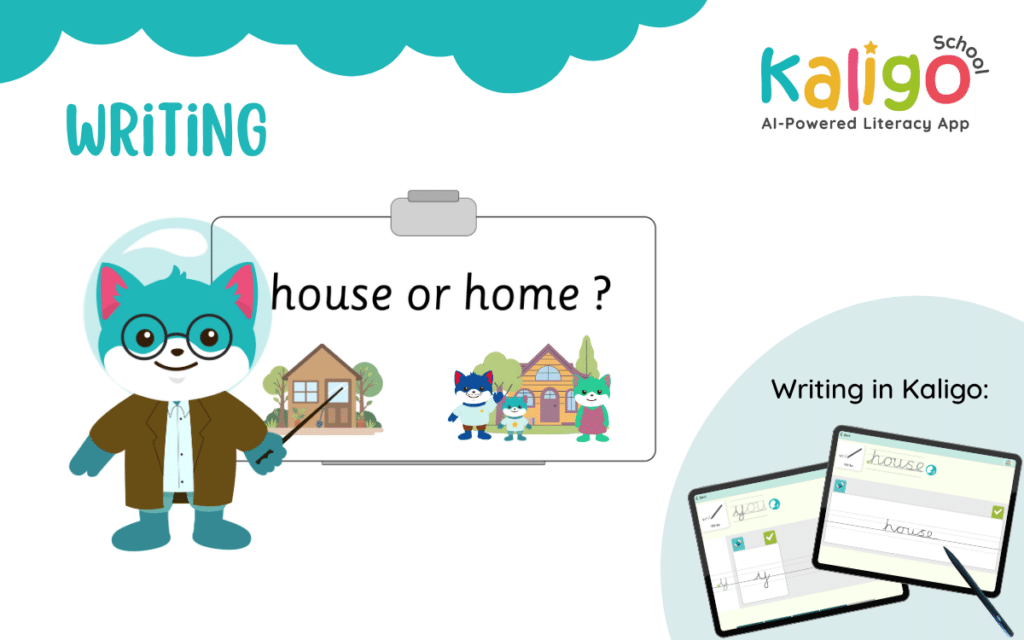
Kaligo supports Writing as a combination of structure and creativity by first developing essential pre-writing skills and then guiding children toward more advanced written expression. Through tracing, drawing, and pattern-based activities, the app strengthens fine motor control, hand–eye coordination, and pencil (or stylus) grip, helping children build the physical foundations needed for writing. Kaligo also encourages correct letter formation, spacing, and posture habits, which contribute to greater control and writing fluency.
Grammar, Spelling and Punctuation in Early Years Literacy
Grammar, Spelling and Punctuation are essential elements of literacy that ensure written communication is clear, accurate, and meaningful. These skills enable children to understand how language is structured and how ideas can be expressed correctly. Throughout primary schooling in the UK, students develop these competencies through a systematic approach that includes:
- Grammar: learning how words function within sentences, including sentence structure, verb tenses, and agreement.
- Spelling: recognising common spelling patterns and rules, and applying them when writing.
- Punctuation: using marks such as full stops, commas, and question marks to organise and clarify meaning.
- Accuracy: improving precision in writing to avoid misunderstandings.
- Application: using grammar, spelling, and punctuation correctly across different types of texts.
Through regular practice and reinforcement, children become more confident and accurate in their writing. Mastering these skills is essential for effective communication and supports overall literacy development.
Supporting Grammar, Spelling and Punctuation Development with Digital Tools
Kaligo supports the development of Grammar, Spelling, and Punctuation by reinforcing accuracy and structure through interactive and adaptive writing activities. As children trace and write words and sentences, they become familiar with correct spelling patterns and common word forms, helping them recognise and apply spelling rules in context.
Through guided tracing and writing exercises with immediate feedback, learners can quickly identify and correct mistakes, strengthening accuracy and building confidence over time. Students have the possibility to focus on their spelling skills though two dedicated spelling exercises. To strengthen active recall, students can have a look at the word before trying to write it out themselves. The word is firstly shown to the children and will then get covered up as soon as they begin writing. The second spelling exercice allows children to focus on listening to and understanding the word before attempting to write it down with the correct spelling.
For grammar, Kaligo uses sentence-based activities that expose students to proper word order, agreement, and punctuation. By working with complete sentences, learners develop an intuitive understanding of language structure and gradually apply these rules in their own writing.
Speaking and Listening in Early Years Literacy Development
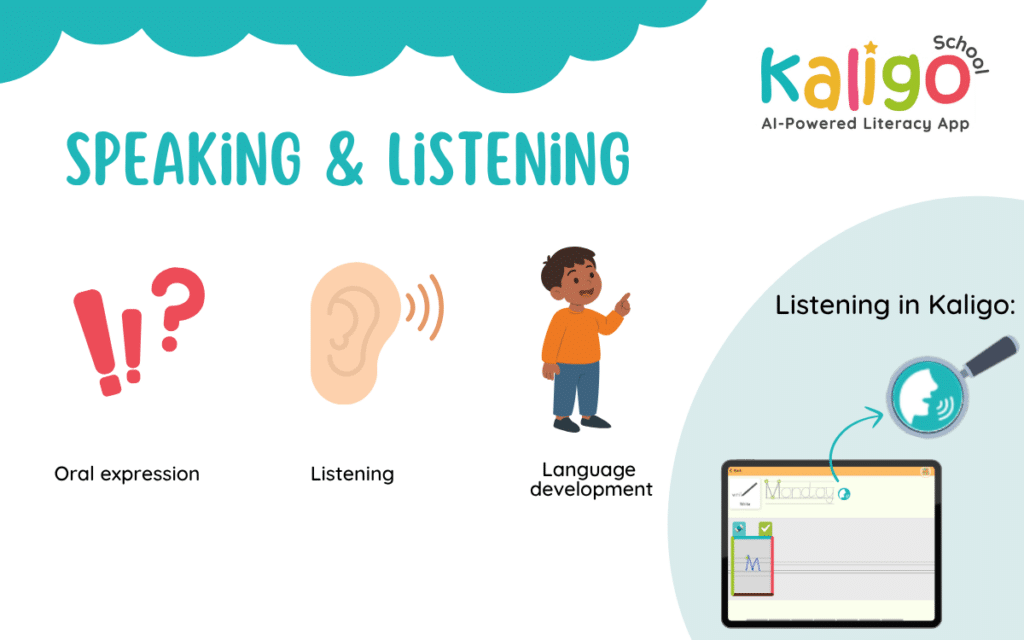
Speaking and Listening are key components of literacy that support effective communication. These skills allow children to express their ideas clearly and understand others. In UK primary schools, students develop these abilities through activities such as:
- Oral expression: speaking clearly and confidently.
- Listening: understanding instructions and discussions.
- Interaction: participating in conversations and asking questions.
- Vocabulary development: learning and using new words.
These skills help children communicate effectively and support their overall literacy development.
Supporting Speaking and Listening Development with Digital Tools
Kaligo supports Speaking and Listening by reinforcing vocabulary through interactive writing. As children trace and write words while hearing them, they improve listening comprehension and oral expression. Kaligo helps learners recognise and reuse vocabulary, building confidence in clear speech. By following instructions and audio prompts, children develop attentive listening skills. Though focused on writing, these repeated experiences enhance communication and overall literacy.
Benefits of Literacy in Early Years Education
The Importance of Early Literacy for Academic Success
Literacy skills form the foundation for a wide range of learning and development. They underpin children’s ability to build automaticity (handwriting) and accuracy (spelling) , which are essential for accessing the curriculum and developing confidence across all areas of education.
In UK primary schools, strong literacy skills are not just important for reading and writing, they are the foundation that supports word recognition, reinforces sounds and letters, and strengthens overall communication and thinking in every subject.
- Foundation for all learning: literacy supports the development of formation, spacing, speed, and accuracy, helping children access and understand content in subjects such as mathematics, science, and history.
- Building academic success: secure literacy skills boost reading and writing, providing the groundwork for achieving well and progressing throughout education.
- Wider impact: as automaticity and accuracy develop, literacy frees up cognitive capacity for comprehension and supports faster recall (reading), enabling deeper understanding and learning.
Developing literacy skills early is therefore essential, as they serve as the building blocks for success across the entire curriculum and beyond.
The Role of Literacy in Achieving Personal Development Goals
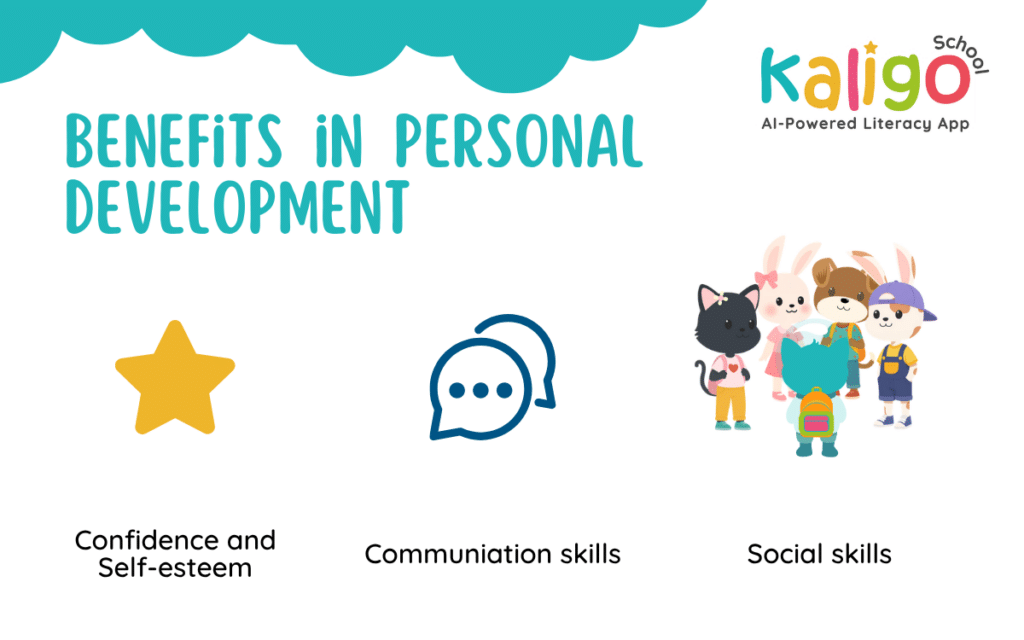
Literacy is essential for children’s personal development, as it helps them express themselves and interact with others effectively. Strong literacy skills contribute to greater confidence and improved social interactions.
- Confidence and self-esteem: enables children to express their ideas clearly and feel more secure in their abilities.
- Communication skills: helps students speak, listen, read, and write effectively in different situations.
- Social skills: supports interaction with others through discussion, cooperation, and understanding.
Developing literacy therefore helps children grow both academically and as people.
Try out Kaligo to support Literacy in Early Years
Kaligo offers a fun, interactive way to support children’s literacy development, helping them build strong skills in reading, writing, spelling, and language comprehension. Through engaging, playful activities, children stay motivated while practising regularly and growing in confidence as communicators.
With personalised feedback and adaptive exercises, Kaligo supports every child in learning at their own pace, reinforcing key foundations like phonics, vocabulary, and sentence construction. It’s the ideal companion for UK educators looking to drive literacy outcomes in an engaging way.
Ready to see the impact in your classroom? Try Kaligo with a free 14-day trial and give your students hands-on, guided practice in a supportive and stimulating learning environment!